Showing posts with label News. Show all posts

World's oldest wooden statue twice as old as pyramids

0

Bookmark and Share

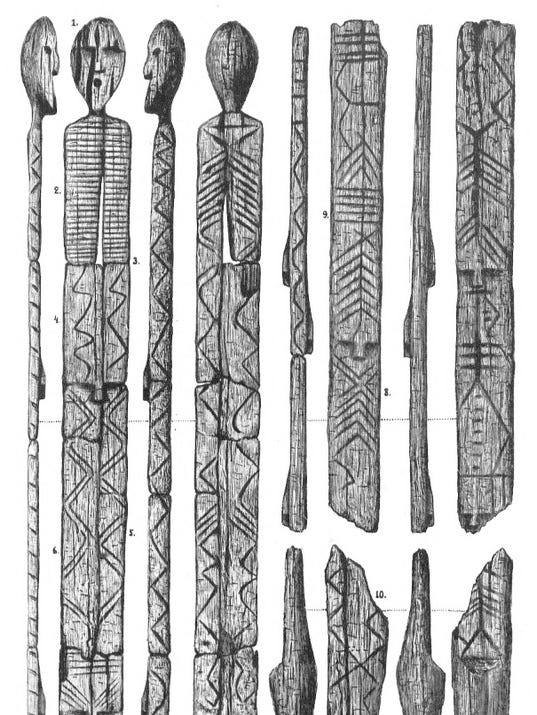
(NEWSER) – When scientists first tried in 1997 to date the famous Shigir Idol wooden sculpture —originally found in a Siberian peat bog in 1890—radiocarbon dating suggested the art was so old the findings were widely disputed. Now, armed with better tech, scientists turned to one of the world's most advanced accelerated mass spectrometry labs in Germany to put the issue to rest, and are announcing that Shigir Idol is indeed ancient—in fact, at 11,000 years of age it's actually 1,500 years older than first thought, reports the Siberian Times. Not only is it the oldest known wooden sculpture, but it's more than twice as old as the Great Pyramid of Giza, three times as old as the ancient city of Babylon, and five times as old as the ruins of Al Khazneh in the ancient city of Petra, reports the Huffington Post.
Microbes that eat away at organic matter don't like bogs, reports Atlas Obscura, which makes them particularly good at preservation. Thus the 9-foot Shigir Idol (which stood 17 feet tall before parts were pilfered during 20th century political turmoil) was preserved "as if in a time capsule" 11 millennia after it was cut from a 157-year-old larch tree. The resulting wooden figure is covered with "encrypted" shapes whose message remains "an utter mystery to modern man," one Russian academic has said. "We study the Idol with a feeling of awe. This is a masterpiece, carrying gigantic emotional value and force, a unique sculpture; there is nothing else in the world like this." He added that the creators "lived in total harmony with the world, had advanced intellectual development, and a complicated spiritual world."
Read More >>

Japan is hammered by a slow-moving typhoon

0

Bookmark and Share
Floodwaters flow from the burst Kinugawa river (top) into a residential area in Joso, Ibaraki Prefecture


A person inside a house waves to a helicopter as the house is surrounded by floodwaters from a river in Joso, Ibaraki prefecture, northeast of Tokyo. Heavy rain is pummeling Japan for a second straight day, overflowing rivers and causing landslides and localized flooding in the eastern part of the country.


A family watches TV news at an evacuation center after taking shelter in Joso, Ibaraki prefecture, northeast of Tokyo.


An elderly man is carried by a firefighter after being rescued by a helicopter in Joso, Ibaraki prefecture, northeast of Tokyo


Residents wait for help while sitting on the roof of their house northeast of Tokyo. Heavy rain is pummeling Japan for a second consecutive day, overflowing rivers and causing landslides and localized flooding in the eastern part of the country.


People wait for help as the vehicles are submerged northeast of Tokyo.


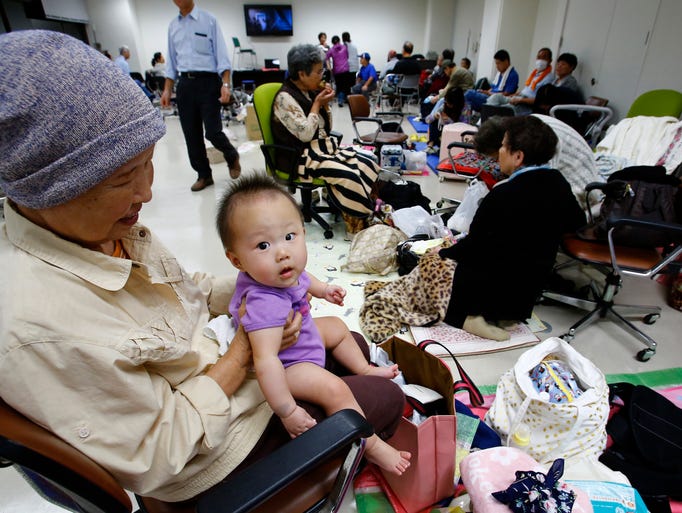
A woman holds her grandchild as evacuees take refuge in a City Hall in Joso, Ibaraki prefecture, northeast of Tokyo on Sept. 


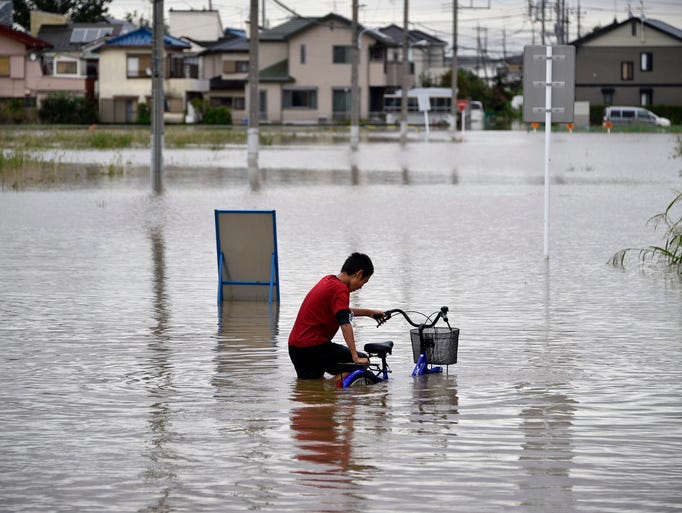
A young boy pushes a bicycle north of Tokyo.

Read More >>

Ancient fossils in African cave are tantalizing glimpse of early man

0

Bookmark and Share

One of the richest collections of early-human fossils ever found has been hauled out of an African cave, thanks to the efforts of a handpicked team of scientists slender enough to fit through ancient narrow passageways, researchers announced today.
The fossils, discovered in the dark reaches of the Rising Star cave in South Africa, belong to a new species that arose at the dawn of the family that includes modern humans, the researchers say in a paper in the scientific journal eLife.
The fossils' age is unknown, but they could be more than 2.5 million years old. Or they could be relatively recent - in the grand scheme of things. Homo sapiens emerged in Africa roughly 200,000 years ago, so the bones are at least that old.
What's more, the bodies may have been deliberately placed in the cave, suggesting that long-ago human relatives were engaged in ritual disposals of their dead.
"It's enormously surprising to see a very primitive member of the genus, something with this small a brain," engaged in an activity that was thought to be unique to modern humans, study co-author Lee Berger of South Africa's University of the Witwatersrand told reporters Wednesday. "None of us expected it."

The new species is a strange mishmash of parts. It had hands and feet much like those of other members of the biological group called Homo, which includes our own species, Homo sapiens. Its brain, though, was only about as big as an orange.
The Rising Star ancient humans could manipulate objects with their nimble hands, but their highly curved fingers also made them adept climbers. Their Homo-like feet and long legs show they could walk long distances, but their shoulders are also suited for climbing. The researchers call them Homo naledi, after the word for "star" in the African language Sotho.
The first inkling of the 1,550-plus bits of fossil, representing at least 15 individuals, came from cavers helping Berger prospect for ancient remains. One slot leading to the fossil chamber is just over seven inches wide – less than the width of a sheet of notebook paper.
It took a team including six female scientists, chosen for their small size and research expertise, to retrieve the fossils. The scientists suspect that the bodies were deliberately dropped or laid into the chamber over a long period.
Read More >>

The Short List: Obama scores on Iran deal; meet Homo naledi; NYPD claims case of mistaken identity

0

Bookmark and Share

Republicans say fight over Iran nuke deal ain't over yet
President Obama scored a big win Thursday as Senate Democrats blocked a resolution to reject the Iran nuclear deal. The House and Senate has a week to vote for a resolution of disapproval, or the agreement will take effect. What is the deal anyway? It means the U.S. and five other world powers will lift sanctions on Iran. In return, Iran says it won't develop nuclear weapons, at least for a decade. Republicans, particularly those running for president in 2016, had strong words of opposition: "It's going to be holy hell," said Sen. Lindsey Graham of South Carolina.
A cave of wonders. And deep inside, a new human species. Meet Homo naledi.
Tantalizing fossils were discovered in the dark reaches of a cave called Rising Star inSouth Africa. They're being billed as the newest branch on the human evolutionary tree. What the scientists found. Naledi is a strange mishmash of parts. It had hands and feet much like those of other members of the biological group called Homo, which includes, Homo sapiens (i.e., us). Its brain, though, was only about as big as an orange. Who the scientists were. It took a team including six female scientists, chosen for their small size and research expertise, to retrieve the fossils. One slot leading to the fossil chamber is just over 7 inches wide. Why "naledi"? It's the word for "star" in the African language Sotho. How old are the bones, really? The fossils' age is unknown, but they could be more than 2.5 million years old. Or they could be relatively recent — in the grand scheme of things. Homo sapiens emerged in Africa roughly 200,000 years ago, so the bones are at least that old. More on the naledi fossils from National Geographic.
NYPD says ex-tennis player was thrown to the ground in case of mistaken identity

The latest face in the use of excessive force may be a familiar one. American ex-tennis player James Blake was standing in front of his hotel this week when he was tackled to the ground and cuffed by a plainclothes NYPD officer. New York Police CommissionerBill Bratton said it was a case of mistaken identity, and Blake "looks like the twin brother" of the suspect. Though Bratton defended the officer, he said he'd like to apologize to Blake in person. Tennis stars have come out in force in support of Blake, including Andy Roddick who tweeted: "James is the most honest and straightforward guy I know. It's ridiculous what happened." Blake, for his part, said: "I do think most cops are doing a great job keeping us safe, but when you police with reckless abandon, you need to be held accountable."
Read More >>

Syrian ISIS suspect 'is sleeping rough in Calais refugee camps in the hope of sneaking into the UK to wage terror' Read more: http://www.dailymail.co.uk/news/article-3229134/Syrian-ISIS-suspect-sleeping-rough-Calais-refugee-camps-hope-sneaking-UK-wage-terror.html#ixzz3lOmW2sDi Follow us: @MailOnline on Twitter | DailyMail on Facebook

0

Bookmark and Share


A frantic manhunt is underway for a suspected Islamic State jihadi hiding in Calais and plotting to sneak into Britain to launch a terrorist attack.
French police have been scouring the port for the alleged fanatic, who left the Middle East at the end of last month and travelled overland to Europe.
But he has evaded officers, possibly by hiding among the 3,500 migrants living in the ‘Jungle’ camp on the outskirts of the town. 


The man has been classified as being a type-S criminal, one who is considered a potential threat to the state.
The police dossier includes a photo, a description, details of his alleged crimes and instructions to officers about his potential risk to others, the paper said.
Officers have been ordered to place the unnamed man under arrest and to proceed with caution.
There has long been concern that IS jihadists might attempt to smuggle themselves into Britain through Calais to launch atrocities.
Up to 40 French detectives from an elite unit have previously been reported to be based at Coquelles close to Calais to monitor migrants – preventing infiltration by jihadis and fighting people-smuggler gangs who stow migrants away on ferries and trains to the UK.
The officers are part of the Brigade Mobile de Recherche, which liaises with intelligence agencies.
Authorities have previously insisted that they are successfully stopping suspected terrorists. 
Speaking in May, a spokesman for the Calais local government said: ‘There is full and complete vigilance in Calais with regard to threat by jihadists or other criminal networks with potential involvement in people smuggling.’


As well as the migrants in the Jungle camp, there are 120 women and children in sheltered accommodation at a former children’s summer camp nearby.
An estimated 1,500 more migrants, mostly from Africa and the Middle East, are living on wasteland close to the motorways leading to the ferry port. 
As well as attempting to smuggle themselves in on lorries, many make repeated attempts to break into the Eurostar station at the French end of the Eurotunnel.
At one point in the summer, stowaways on trucks were being caught at the rate of 90 an hour.

Read More >>

Born to rock: Newborn baby daughter of heavy metal singer flashes Rock 'n' Roll sign at just 10 days old Read more: http://www.dailymail.co.uk/femail/article-3230073/Rock-n-Roll-baby-mimics-deathrash-dad-making-tiny-hand-horns-crib.html#ixzz3lOlARX3r Follow us: @MailOnline on Twitter | DailyMail on Facebook

0

Bookmark and Share


Most parents rock their children to sleep with a soothing lullaby.
But Nao Hazuki is not most parents.
Mr Hazuki, who fronts the Japanese heavy-metal band Grollschwert, posted a photo of his baby girl flipping the hand-horns in the crib - proving the apple doesn't fall far from the tree.


The photo, which Mr Hazuki first posted on Twitter in September last year just 10 days after welcoming his daughter into the world, has gone viral again this week.
The image was posted on the Facebook page Trending in China last night, and has already had more than 1,200 likes and nearly 300 shares.
Dubbed 'Rock 'n' Roll Baby, commenters shared their thoughts on the tiny bub, with one suggesting she must have been 'listening to heavy metal in the womb'.  

Read More >>

A shameful injustice: Campaign fights to overturn conviction of Marine given life for 'murdering' Taliban in the heat of battle as shocking flaws in his trial are revealed Read more: http://www.dailymail.co.uk/news/article-3229984/A-shameful-injustice-Mail-fights-overturn-conviction-Marine-given-life-murdering-Taliban-heat-battle-shocking-flaws-trial-revealed.html#ixzz3lOjDpUlG Follow us: @MailOnline on Twitter | DailyMail on Facebook

0

Bookmark and Share

A Royal Marine jailed for life for killing a Taliban insurgent was robbed of justice after crucial evidence was ‘deliberately withheld’ from his court martial, it is claimed today.
It meant Sergeant Alexander Blackman – believed to be the only British serviceman ever convicted of murder on the battlefield – was locked up as a ‘political scapegoat’ for failings by top brass, say supporters.

Today a campaign spearheaded by legendary thriller writer Frederick Forsyth is being launched to mount a fresh legal appeal to free Blackman. 
The jailing of the veteran commando, known as ‘Marine A’ at his court martial in 2013, triggered a public outcry. 

Now a painstaking Mail investigation can reveal:
  • Evidence that might have resulted in a lesser charge of manslaughter was ‘deliberately withheld’;

  • A high-flying colonel who was blocked from telling the truth to the court martial called it ‘a failure of moral courage by the chain of command’;

  • The colonel was so disgusted that he resigned his commission;

  • Court martial panel members sent a message to Blackman – who is eligible for parole after eight years – apologising for the length of his sentence.

The Mail has seen confidential papers claiming the panel members who decided Blackman’s fate were deliberately kept in the dark and were therefore ‘blind to facts’ that would help him.

The court martial was never given evidence of alleged key operational failings by his commanders that meant his troop was scandalously isolated, under-manned, under-resourced and under daily Taliban assault – all directly affecting his state of mind at the time of the shooting. This led to Blackman not receiving a fair trial, it is claimed.


Read More >>

Suicide car bomb near Kabul airport kills 5, Taliban claims responsibility

0

Bookmark and Share
The Afghan president called on Pakistan on Monday to crack down on the Taliban after a suicide car bombing earlier in the day near Kabul's international airport killed five people, the latest in a wave of deadly attacks in the capital.
In a televised address, Ashraf Ghani also blamed neighboring Pakistan for what he described as Islamabad's support to the insurgents whose war against Kabul is now nearing its 14th year, and said he was sending a delegation to Islamabad later this week to demand a stop to this.
"We know they have sanctuaries there, we know they are active there," Ghani said, referring to Taliban leaders living in Pakistan. "We need all those activities to be stopped."
There was no immediate reaction from Islamabad. Pakistan has in the past denied supporting the Taliban.
Since assuming office a year ago, Ghani has pursued closer relations with Pakistan, which wields influence over the insurgent group, hoping that it could use that influence to bring the Taliban into peace negotiations.
Pakistan hosted the first official round of Kabul-Taliban negotiations last month, but a second round that was due at the end of last month was indefinitely postponed after the Afghan government announced the death over two years ago of the reclusive Taliban leader, Mullah Mohammad Omar.
The one-eyed Mullah Omar had hosted Osama Bin Laden's al Qaeda in the years leading up to the Sept. 11, 2001, attacks. He had not been seen in public since fleeing over the border into Pakistan after the 2001 U.S.-led invasion that ousted the Taliban. Since the announcement of his death, the Taliban have been torn by infighting and rivalries for the leadership post.
On Monday, Ghani appeared to take a step back on the peace talks.
"We don't want Pakistan to bring the Taliban to peace talks, but to stop the Taliban's activities on their soil," he said.
Only hours earlier, a suicide car bombing at a busy roundabout near the entrance to the Kabul airport killed at least five people and wounded 16, officials said. The Taliban quickly claimed responsibility for the attack.
The Kabul provincial police chief, Abdul Rahman Rahimi, told The Associated Press that a car packed with explosives blew up at the busy intersection.
It was the latest in a series of deadly attacks on the capital, which since Friday have killed more than 50 people and wounded hundreds.
The Taliban have claimed responsibility for all the attacks but one -- a truck bomb explosion that flattened a city block, killed 15 people and wounded 240 as they slept in the early hours of Friday.
It is widely believed the truck in that attack detonated prematurely -- CCTV footage shown on Afghan television purportedly showed the truck hitting a speed bump and then blowing up.
Earlier this month, the Afghan intelligence service disclosed that Mullah Omar had been dead for more than two years. The disclosure, later confirmed by the Taliban, triggered the internal succession dispute and raised questions about the future direction of the insurgency.
Ghani said the recent attacks showed "the war has changed shape."
"The enemy who was fighting to gain territory and claim victory, has now had its backbone broken," he said of the insurgent group. "It is so desperate now that it has turned to cowardly attacks against innocent people just to weaken people's morale."
Read More >>

South Korea blames North for mine blast that injured 2 soldiers

0

Bookmark and Share


South Korea warned North Korea Monday that Pyongyang would face a "pitiless penalty" after it blamed the Communist nation for laying two land mines that maimed two South Korean soldiers last week.

The mines exploded Aug. 4 in the Seoul-controlled southern part of the heavily-fortified Demilitarized Zone (DMZ). The two wounded soldiers had been on a routine patrol at the time. One of the injured lost both legs, while the second lost one leg.
South Korea restarted propaganda broadcasts across the border for the first time in 11 years Monday in retaliation for the mine incident.
Monday’s loudspeaker broadcasts were in the western and center portions of the world's most heavily armed border, said Defense Ministry spokesman Kim Min-seok. He said the broadcasts emphasized that the mine explosions were a provocation by the North.
In the past, propaganda broadcasts typically blared messages about alleged North Korean government mismanagement, human rights conditions, the superiority of South Korean-style democracy as well as world news and weather forecasts.
The broadcasts will further test tensions between the Koreas and likely infuriate the North, which is extremely sensitive to any outside criticism of the authoritarian leadership of Kim Jong Un.
It was unclear how long the broadcasts will continue. South Korean officials said they may take additional punitive measures depending on how North Korea reacts.
South Korea's Defense Ministry said Monday that it believes North Korean soldiers secretly crossed the border and laid the mines because the splinters from the explosions were from wood box mines, which are used by North Korea. South Korean authorities claimed that the mines were laid around a door on the South Korean side of the border that opened onto the DMZ.
South Korea's Joint Chiefs of Staff issued a statement urging North Korea to apologize and punish those responsible for the mine explosion. There was no immediate official response from Pyongyang.
The U.S.-led U.N. Command conducted an investigation that blamed North Korea for the mines. It condemned what it called violations of the armistice that ended fighting in the war, which still technically continues because the participants have never signed a peace treaty.
South Korea's Yonhap News Agency reported that South Korean investigators had determined that the explosion was intended to undermine joint military exercises by U.S. and South Korean troops scheduled to take place next week.
More than a million mines are believed to be buried inside the DMZ, and North Korean mines have occasionally washed down a swollen river into the South, killing or injuring civilians. But North Korean soldiers crossing the border and planting mines is highly unusual.
The explosions come amid continuing bad feelings between the rival Koreas over the establishment of a U.N. office in Seoul tasked with investigating the North's human rights record. North Korea also refuses to release several South Koreans it has detained. Things are expected to get worse next week when Seoul and Washington launch annual summertime military drills, which the allies say are routine but North Korea calls an invasion rehearsal.
In 2004, the two Koreas stopped the decades- long practice of propaganda warfare along the border to reduce tension. The practice had included loudspeaker and radio broadcasts, billboards and leaflets. In 2010, South Korea restarted radio broadcasts and restored 11 loudspeakers as part of punitive measures taken after a warship sinking blamed on North Korea that killed 46 South Korean sailors earlier that year. But South Korea didn't go ahead with plans to resume loudspeaker broadcasts at the time.
Read More >>

AP Interview: Head of World Food Program says funding outlook for Syrian refugees is 'bleak'

0

Bookmark and Share
The head of the World Food Program says in an interview that funding prospects are "bleak" and Syrian refugees likely face more cuts in food aid.
Ertharin Cousin spoke to The Associated Press on Monday, after meeting a Syrian mother and her eight children in a one-room shelter in the Jordanian capital of Amman.
The woman told Cousin that she struggles to feed her children, keeping hunger at bay with rice, and that she faces eviction because rent money goes toward food.
The WFP chief also met with boys who had to quit school to work and support their families.
Cousin says "need is outpacing the traditional generosity."
In Jordan, about half of WFP beneficiaries, or more than 200,000 refugees, will no longer receive food aid as of September.
Read More >>

Japan restarts nuclear reactor more than four years after Fukushima disaster

0

Bookmark and Share
A power plant operator in southern Japan restarted a nuclear reactor on Tuesday, the first to begin operating under new safety requirements following the Fukushima disaster.
Kyushu Electric Power Co. said Tuesday it had restarted the No. 1 reactor at its Sendai nuclear plant as planned. The restart marks Japan's return to nuclear energy four-and-half-years after the 2011 meltdowns at the Fukushima Dai-ichi nuclear power plant in northeastern Japan following an earthquake and tsunami.
The national broadcaster NHK showed plant workers in the control room as they turned the reactor back on. Tomomitsu Sakata, a spokesman for Kyushu Electric Power, said the reactor was put back online without any problems.
The Fukushima disaster displaced more than 100,000 people due to radioactive contamination and spurred a national debate over this resource-scarce country's reliance on nuclear power.
A majority of Japanese oppose the return to nuclear energy. Dozens of protesters, including ex-Prime Minister Naoto Kan, who was in office at the time of the disaster and has become an outspoken critic of nuclear power, were gathered outside the plant as police stood guard.
"Accidents are unpredictable, that's why they happen. And certainly not all the necessary precautions for such accidents have been taken here," Kan shouted to the crowd of about 300 people.
The Nuclear Regulation Authority affirmed the safety of the Sendai reactor and another one at the plant last September under stricter safety rules imposed after the 2011 accident, the worst since the 1986 Chernobyl explosion.
The Sendai No. 1 reactor is scheduled to start generating power Friday and reach full capacity next month. The second Sendai reactor is due to restart in October.
Yoichi Miyazawa, Japan's industry minister, said Tuesday that the government would "put safety first" in resuming use of nuclear power.
All of Japan's 43 workable reactors were idled for the past two years pending safety checks. To offset the shortfall in power output, the country ramped up imports of oil and gas and fired up more thermal power plants, slowing progress toward reducing its emissions of greenhouse gases.
Miyazawa said nuclear power is "indispensable" for Japan.
"It would be impossible to achieve all these three things simultaneously -- keep nuclear plants offline, while also trying to curb carbon dioxide and maintain the same electricity cost. I hope to gain the public's understanding of the situation," Miyazawa said.
Prime Minister Shinzo Abe has sought to have the reactors restarted as soon as possible to help reduce costly reliance on imported oil and gas and alleviate the financial burden on utilities of maintaining the idled plants.
"There are very strong vested interests to reopen nuclear reactors. Accepting them as permanently closed would have financial implications that would be hard to manage," said Tomas Kaberger, chairman of the Japan Renewable Energy Foundation.
Utilities are seeking approvals to restart 23 reactors, including the other Sendai reactor.
The government has set a goal to have nuclear power meet more than 20 percent of Japan's energy needs by 2030, despite the lingering troubles at the Fukushima plant, which is plagued by massive flows of contaminated water leaking from its reactors.
Removal of the melted fuel at the plant -- the most challenging part of the 30-to-40-year process of shutting it down permanently -- will begin only in 2022.
Still, the government favors restarting other plants judged to meet the new safety criteria, for both economic and political reasons. Japan invested heavily in its nuclear power program and many communities rely on tax revenues and jobs associated with the plants.
Japan also faces pressure to use its stockpile of more than 40 tons of weapons-grade plutonium, enough to make 40 to 50 nuclear weapons. The plutonium, as fuel called MOX, will be burned in reactors since the country's nuclear fuel recycling program at Rokkasho in northern Japan has been stalled by technical problems.
To burn enough plutonium, Japan needs to restart as many as 18 reactors. Nuclear experts say this could pose a challenge.
Read More >>